SEO migration services that protect your rankings when the site changes
A new design, a new platform or a new domain can wipe out years of organic traffic in a week. Almost always the cause is not the move itself but what was never mapped: old URLs, redirects, internal links, structured data. I plan the migration before the build starts, test it before launch and watch Search Console after, so the new site keeps what the old one earned.
How migrations lose traffic
SEO brought in after the design is signed off
By then the URL structure, templates and navigation are fixed, and every change costs developer time. The cheapest moment to protect rankings is the planning stage, before a single page is built.
Redirects mapped to the homepage
Sending every old URL to the homepage, or to a loosely related page, tells Google the old content is gone. Each URL that earned traffic needs a one-to-one redirect to its closest equivalent.
Content and titles quietly changed
A redesign often trims copy, rewrites headings and drops internal links. Pages that ranked because of that content stop matching the query, even when the redirect is correct.
No benchmark, so no way to prove the damage
If rankings, traffic and indexed pages were not recorded before launch, nobody can say what was lost or how fast it recovered. Fixing it later becomes guesswork.
What I do on an SEO migration
Pre-migration benchmark
A crawl of the old site, plus Search Console, analytics and rank data for the pages and queries that earn traffic and leads. This is the baseline everything is measured against.
URL inventory and redirect map
Every URL that has traffic, links or rankings gets a one-to-one 301 to its closest new equivalent. Pages with no equivalent are flagged for a decision, not silently dropped.
Requirements for the new build
A written spec for your developers: titles, headings, canonicals, internal links, structured data, robots rules, XML sitemaps and hreflang if you sell across countries.
Staging review
I crawl the staging site before launch and compare it with the old one. I check redirect chains, noindex tags left on by mistake, blocked resources and missing content.
Launch-day checks
On the day: redirects live, robots.txt correct, new sitemap submitted, and Search Console set up for the new property, plus a change-of-address for domain moves.
Post-launch monitoring
For the first weeks I watch indexing, crawl errors, rankings and clicks against the benchmark, and fix what appears quickly, while Google is still deciding how to treat the new site.
What you get
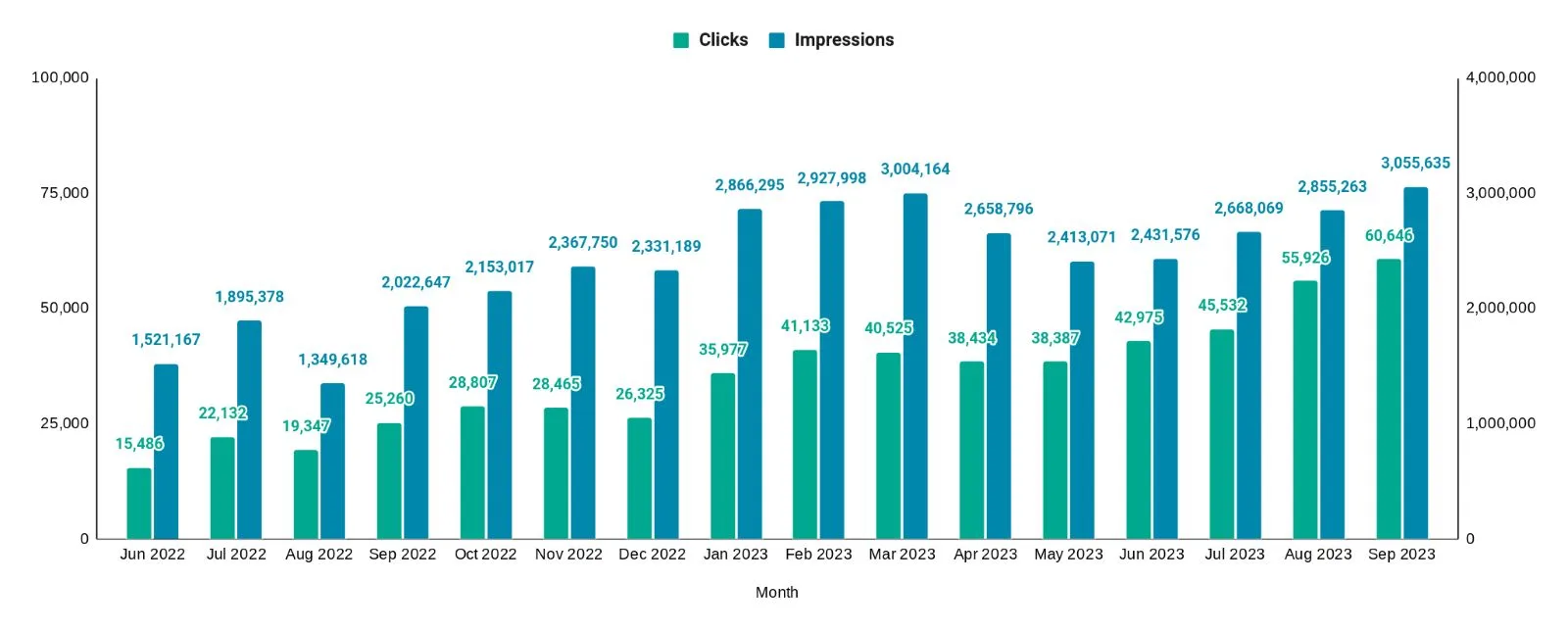
Aashni & Co: organic clicks from 15,486 to 60,646 a month
I have not published a case study built around a single migration, and I will not dress one up. What I can show is the discipline migrations depend on. For Aashni & Co, a large and changing product catalogue needed indexing and structured data kept clean while clicks grew from 15,486 to 60,646 a month, with organic orders from 13 countries. Protecting a catalogue of that size means knowing exactly which URLs matter, and that is the same inventory a migration starts from.
What it costs
Migration support is quoted as a fixed project fee after I review the size of the site and the type of move, and can sit alongside the 3D Growth System™ retainer, which starts from $1,545 a month with a 6-month minimum. The scope and fee are confirmed on a call before you commit.
Questions buyers ask
It is the process of changing a website's design, platform, URLs or domain while keeping the search rankings and traffic it already earns. It covers planning, redirect mapping, pre-launch testing and monitoring after go-live.
At the planning stage, before the design and URL structure are finalised. Changes are far cheaper to make then than after the site is built.
A short dip is normal, because Google needs time to process the new site. With a clean redirect map and matching content, most sites recover in weeks. Without one, the loss can be large and slow to fix.
Planning and benchmarking usually take two to four weeks depending on site size, and monitoring continues for at least a month after launch. Domain changes are watched for longer.
Often yes. I compare the old and new URLs, find where redirects or content broke, and fix them in order of lost traffic. The sooner it is caught, the better the recovery.
Yes. Domain changes, HTTP to HTTPS moves, subdomain to subfolder merges and platform changes such as WordPress, Shopify or custom builds all follow the same plan.
It depends on the number of URLs and the kind of move. I quote a fixed project fee after reviewing the site and confirm it on a call.
No. Nobody controls how Google treats a new site. I guarantee a documented plan, tested redirects and monitoring, so any problem is found and fixed fast.
Tell me where your traffic and leads are stuck.
A 30-minute call with me, Sagar Dubey. You leave with the two or three things I would fix first, whether or not we work together.