SEO for manufacturing companies that brings in RFQs, not just visits
Industrial buyers search by part, grade, standard and capacity, then send an enquiry to the two or three suppliers whose pages answer the question. I build the product and specification pages that get you onto that shortlist, and track which searches actually produce quotations.
Why manufacturers lose RFQs they should win
A catalogue PDF instead of product pages
Google cannot rank a brochure download for a buyer typing a grade, size or standard. Each product line needs its own crawlable page with specifications in text, not locked in an image or PDF.
Pages that describe the factory, not the part
An About Us page with the plant history ranks for nothing a buyer searches. Procurement teams want dimensions, material, tolerances, certifications, minimum order and lead time.
Dealers and marketplaces outrank the maker
Directories and trading portals often rank above the manufacturer for your own products. A well-built product page with real specs and a clear quote path can win that result back, and the portals stay as an extra channel.
No way to tell which search became an RFQ
If the enquiry form and the phone number are not tracked, you cannot tell a spec search that led to a purchase order from a student reading about your process. Reports then show traffic and nothing about orders.
What I do on a manufacturing SEO engagement
Buyer-language keyword research
I map how engineers and buyers search: product, grade, standard, application and 'manufacturer in [city]' variants. The research separates quote-ready searches from learning searches, so each gets the right page.
Product and specification pages
One page per product line or variant group, with specifications in plain text, a table, material and standards, applications, capacity, and a visible request-a-quote path. Written with your production team's input so the numbers are right.
Technical clean-up for large catalogues
Thousands of SKUs bring duplicate variants, filter URLs and thin pages. I fix crawl and index control, canonical rules, internal linking and structured data so Google spends its time on the pages that earn quotes.
Trust and compliance signals
ISO and BIS certificates, test reports, export credentials, plant photos and client industries, presented as crawlable content. Industrial buyers check these before they send an enquiry, and so do AI search tools.
Export and regional pages
If you ship abroad or serve industrial clusters, I plan country and region pages only where there is real demand and real capability, rather than copying one template across fifty places.
RFQ tracking and AI search visibility
Form, WhatsApp and call tracking tied to the page and query that produced them, plus an audit of how ChatGPT and Google AI answers describe your products. Reporting is in enquiries and quotation requests.
What you get
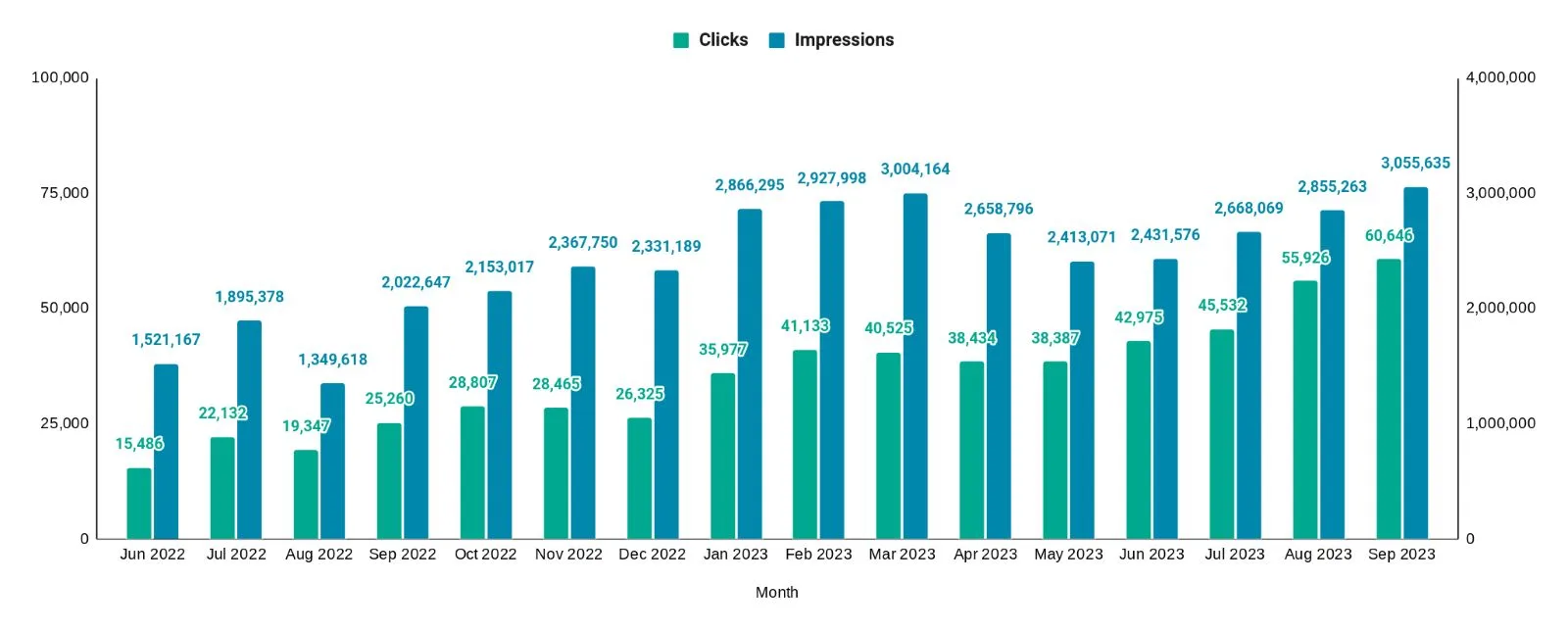
Aashni & Co: organic clicks from 15,486 to 60,646 a month
I have not published a manufacturing case study, and I will not present one that is not real. The closest published proof is catalogue-scale product SEO. On Aashni & Co, a store selling to 13+ countries, query-mapped product pages and catalogue structure took organic clicks from 15,486 to 60,646 a month and produced ₹2.95M+ in revenue. The method for specification pages is the same; your buying journey ends in an RFQ rather than a basket.
What it costs
Manufacturing SEO sits inside the 3D Growth System™ retainer, from $1,545 a month with a 6-month minimum. Scope depends on the number of product lines and how the catalogue is built, and is confirmed on a call.
Questions buyers ask
It is the work of making your products and capabilities show up when industrial buyers search Google and AI tools. That means product and specification pages, technical fixes for large catalogues, trust content such as certifications, and tracking that connects searches to RFQs.
Yes, because procurement teams research suppliers online before they contact anyone. Buyers search part names, grades, standards and 'manufacturer in [city]', and the suppliers whose pages answer those searches get the enquiry. It works best alongside your sales team, not instead of it.
Specific product searches often move within three to six months, because competition per term is lower than in consumer markets. Industrial sales cycles are long, so orders from new enquiries arrive later. I report rankings and enquiries separately.
My retainer starts at $1,545 a month with a 6-month minimum. The price depends on the number of product lines, the size of the catalogue and any export markets, and I confirm scope on a call after reviewing your site.
Do both, for different jobs. Portals bring buyers quickly but you rent that visibility and compete on price. Your own site builds a branded audience, captures specification searches and is the page AI tools cite. I do not work on portal listings.
No. Nobody controls Google. I guarantee a transparent plan, clean technical work and monthly reporting on rankings, qualified enquiries and quotation requests, with no lock-in beyond the minimum term.
A short call with someone who knows the products is enough to start. Specification pages must be accurate, so I draft them from your datasheets and have your engineer approve the numbers before anything is published.
Tell me where your traffic and leads are stuck.
A 30-minute call with me, Sagar Dubey. You leave with the two or three things I would fix first, whether or not we work together.